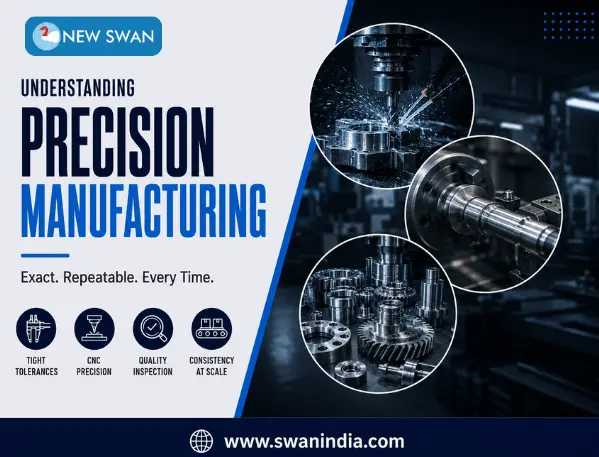

At its core, Precision Manufacturing is about making parts to extremely tight tolerances, sometimes within a fraction of a millimeter. It's not close enough. It's exact, repeatable, and consistent across hundreds or thousands of units.
Think of it this way. If you're making one bracket by hand, small imperfections don't matter much. But if you're making 50,000 of them, and each one needs to fit into an engine or a medical device without fail, there's no room for guesswork. That's the whole point of precision work, consistency at scale, not just accuracy on a single piece.
You've probably interacted with the results of this process today without even noticing. Aircraft components, surgical instruments, engine parts, and the tiny connectors inside your laptop all depend on parts machined to strict specifications.
Automotive gears, hydraulic fittings, and turbine blades are good examples too. Each of these has to perform under stress, heat, or pressure, and a part that's even slightly off can fail in ways that matter, sometimes in ways that put people at risk. That's why this level of accuracy isn't optional in industries like aerospace, defense, and healthcare.
A company working in this space isn't just running machines. It's managing an entire system built around quality control, and that includes CAD design, programming, machine setup, material sourcing, and inspection at every stage of production.
This is roughly what a company like Swan India focuses on daily. Not just producing parts, but making sure every batch holds up to the same standard as the last, whether it's a prototype run or a full scale production order. The reputation of a manufacturer often comes down to how consistently they can repeat that process without cutting corners.
There isn't just one way to shape a part. A few common processes you'll come across are
Most manufacturers don't rely on just one of these. A single finished part might pass through two or three different processes before it's ready to ship.
CNC, short for Computer Numerical Control, is one of the biggest reasons modern precision work is even possible. A computer directs the machine's movements, cutting or drilling material with a level of consistency that's nearly impossible to match by hand.
That doesn't mean people are out of the picture, though. Someone still has to design the part, write the program, and check the finished output. The machine handles the repetitive motion, and humans handle the judgment calls.
Not all CNC equipment does the same job.
Each type suits a different kind of job, and choosing the wrong one can slow down production or hurt part quality.
This part trips a lot of people up. Precision isn't just about how accurate something is. It's about how consistent the results are across repeated attempts. A machine could hit the exact right size once and miss slightly the next ten times. That's not precise, even if one result looked perfect.
Manufacturers use tools like micrometers, calipers, and coordinate measuring machines to check parts against a set tolerance range. If a part is supposed to measure 10mm with a tolerance of plus or minus 0.02mm, every single unit needs to fall within that window, not just most of them.
Honestly, yes, and demand isn't slowing down. Basic machine operation can be learned in a matter of months, while running multi axis CNC equipment or writing complex programs takes years of hands-on experience.
As more factories lean on automation, someone still needs to understand what's happening inside the machine when things don't go as planned. That knowledge doesn't become obsolete. If anything, it becomes more valuable as the equipment gets more advanced.
At the end of the day, Precision Manufacturing comes down to one idea, getting the same result, exactly right, over and over again. It's not flashy, but it's the reason cars run safely, medical devices function properly, and machinery holds up under pressure.
Companies like Swan India build their entire process around that idea, because in this line of work, mostly accurate simply isn't good enough. Whether you're trying to understand the basics or figure out who to trust for your next production run, knowing how this process actually works makes those conversations a whole lot easier.