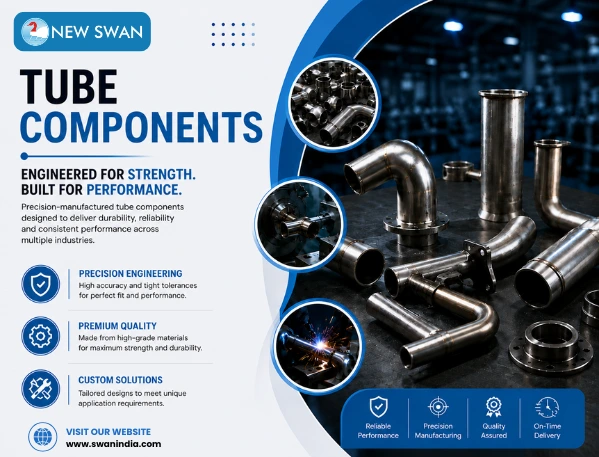

Tube components are precision-manufactured parts created from metal tubes using specialized processes such as cutting, bending, forming, welding, machining, and surface finishing. These components are engineered to meet exact dimensional requirements while providing excellent strength, durability, and corrosion resistance.
Available in various shapes, diameters, wall thicknesses, and materials, tube-based parts are designed to suit different industrial applications. Depending on the project requirements, manufacturers use carbon steel, stainless steel, alloy steel, or aluminum to produce reliable and high-performance solutions.
Their lightweight yet robust construction makes them ideal for applications where both strength and weight optimization are essential.
These precision-engineered parts are widely used across multiple industries due to their versatility and reliability.
Common applications include:
Because these industries demand consistent performance, manufacturers must ensure every component meets strict quality specifications.
Choosing a manufacturing partner is more than comparing prices. The right supplier becomes an extension of your production process by delivering dependable products, technical expertise, and continuous support.
An experienced manufacturer helps reduce production risks through:
A trusted supplier also contributes to better product performance, lower maintenance costs, and improved customer satisfaction.
Industry experience demonstrates a manufacturer's ability to understand complex engineering requirements. Companies with years of expertise can efficiently handle challenging designs, tight tolerances, and high-volume production.
Experienced manufacturers are also better equipped to solve technical problems and recommend manufacturing improvements.
Advanced production facilities are essential for maintaining quality and consistency.
Look for manufacturers equipped with:
Modern technology improves production efficiency while minimizing errors and material waste.
Every project has unique requirements. Manufacturers that provide engineering assistance can add significant value throughout product development.
Engineering services may include:
This collaborative approach helps create components that perform efficiently while remaining economical to produce.
The quality of raw materials directly influences component performance.
Reliable manufacturers source certified materials that offer:
Selecting the appropriate material ensures the final product performs reliably under various operating conditions.
Precision manufacturing is essential for producing components that fit perfectly into larger assemblies.
Accurate manufacturing provides several advantages:
Even minor dimensional inconsistencies can lead to production delays and increased maintenance costs, making precision a key consideration when choosing a supplier.
A dependable manufacturing partner implements quality control at every production stage rather than relying solely on final inspection.
A comprehensive quality system generally includes:
This systematic approach helps maintain consistency across both small and large production batches.
Many industries require components designed specifically for their products.
An ideal manufacturing partner should offer customization services such as:
Custom solutions help manufacturers reduce assembly time while improving overall product performance.
Reliable production depends on a stable supply chain.
Before selecting a manufacturer, evaluate their ability to provide:
Consistent delivery schedules help customers maintain uninterrupted production and meet market demand.
Original Equipment Manufacturers require suppliers capable of maintaining strict quality standards over long production cycles.
Trusted manufacturing partners provide:
These strengths allow OEMs to improve efficiency while maintaining consistent product quality.
A successful business relationship is built on more than product delivery. The right partner understands your business goals and works collaboratively to improve product quality, reduce costs, and support future growth.
Swan India combines engineering expertise, advanced manufacturing technologies, and robust quality systems to deliver reliable solutions for customers across automotive and industrial sectors. With a commitment to precision, innovation, and customer satisfaction, the company supports businesses looking for dependable manufacturing partnerships that deliver long-term value.
Selecting the right manufacturing partner requires careful evaluation of technical expertise, production capabilities, quality systems, engineering support, and supply chain reliability. Businesses that invest time in choosing an experienced supplier benefit from consistent product quality, improved operational efficiency, and reduced manufacturing risks.
High-quality Tube Components are essential for ensuring the strength, safety, and performance of modern engineering products. By working with a trusted manufacturer that prioritizes precision, innovation, and continuous improvement, companies can confidently meet customer expectations, enhance product reliability, and achieve sustainable growth in today's competitive global marketplace.