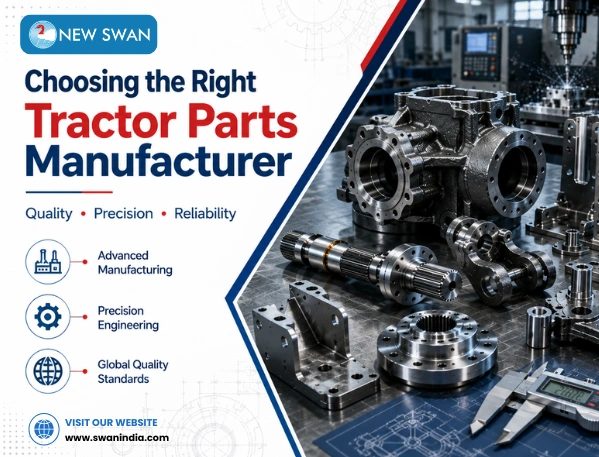

Every tractor consists of numerous components working together under demanding conditions. These parts experience constant stress, vibration, varying temperatures, and exposure to dust, mud, and moisture. Because of this, every component must be manufactured with precision and consistency.
A dependable manufacturing partner contributes to:
Working with an experienced manufacturer also minimizes production risks and ensures every component performs as intended.
Experience is one of the first aspects to evaluate.
Manufacturers with years of expertise understand the complexities of producing precision components for agricultural machinery. They are familiar with technical drawings, engineering tolerances, production planning, and quality inspection processes.
An experienced team is also better equipped to recommend manufacturing improvements, optimize production methods, and maintain consistency across large production volumes.
Before choosing a partner, review their manufacturing capabilities, industries served, and history of delivering components for agricultural applications.
Modern manufacturing depends on advanced production technologies.
A capable production facility should include processes such as:
Having multiple manufacturing capabilities under one roof improves production efficiency and simplifies supply chain management.
It also ensures better coordination between different production stages, resulting in consistent product quality.
Quality is one of the most important considerations when selecting a manufacturing partner.
Reliable manufacturers establish quality control procedures throughout every stage of production — from raw material inspection to final product verification.
Common quality practices include:
Following internationally recognized quality systems demonstrates a manufacturer's commitment to producing dependable components.
The performance of tractor components depends greatly on the materials used during manufacturing.
Different applications require different material characteristics, including:
Selecting the appropriate material helps improve component life and reduces maintenance requirements in demanding agricultural environments.
Manufacturers with strong engineering knowledge can recommend suitable material grades based on application requirements.
Agricultural equipment operates under heavy mechanical loads.
Even minor dimensional variations can affect equipment performance, increase wear, or reduce operational efficiency.
Precision engineering ensures:
Modern manufacturing equipment combined with experienced engineering teams helps maintain consistent accuracy across every production batch.
Business needs often change over time.
Your manufacturing partner should be capable of handling both current production requirements and future growth.
Important considerations include:
Scalable manufacturing operations provide confidence that growing business demands can be fulfilled without compromising quality.
A manufacturing partner should offer more than production services.
Technical expertise can add significant value during product development and manufacturing optimization.
Engineering support may include:
Early collaboration between engineering and production teams often results in improved product performance and more efficient manufacturing.
Timely delivery plays an important role in maintaining production schedules.
Manufacturers with organized supply chain systems can better manage:
Reliable logistics reduce delays and help customers maintain uninterrupted manufacturing operations.
Many companies source components for international markets.
Global buyers generally look for manufacturers that can consistently deliver products meeting customer specifications while maintaining documentation, quality compliance, and dependable production processes.
Manufacturers familiar with export requirements often understand packaging standards, quality documentation, and international business expectations, making cross-border collaboration more efficient.
Sustainable manufacturing is becoming increasingly important across industries.
Many manufacturers are adopting environmentally responsible practices, including:
Sustainability not only benefits the environment but also supports long-term manufacturing efficiency.
Selecting a manufacturing partner should focus on long-term collaboration rather than short-term transactions.
Strong partnerships are built on:
A dependable manufacturer becomes an extension of your business by supporting evolving production requirements and maintaining consistent performance over time.
When businesses look for precision-engineered automotive and industrial components, they value manufacturers with proven capabilities, modern infrastructure, and a commitment to quality.
Swan India has established itself as a trusted manufacturing company by focusing on precision engineering, advanced production processes, and consistent quality standards. With expertise across multiple manufacturing technologies, the company supports customers with dependable components designed to meet demanding industrial applications.
By combining engineering knowledge with modern manufacturing practices, Swan India continues to deliver products that align with the expectations of domestic and international customers.
Selecting the right tractor parts manufacturer requires careful evaluation of manufacturing capabilities, engineering expertise, quality systems, production capacity, and long-term reliability. A well-qualified partner does more than manufacture components — they contribute to better product performance, operational efficiency, and lasting business success.
Taking the time to assess these factors helps ensure that your business partners with a manufacturer capable of supporting both current requirements and future growth. In today's competitive manufacturing landscape, choosing the right tractor parts manufacturer can make a meaningful difference in product quality, customer satisfaction, and long-term business performance.