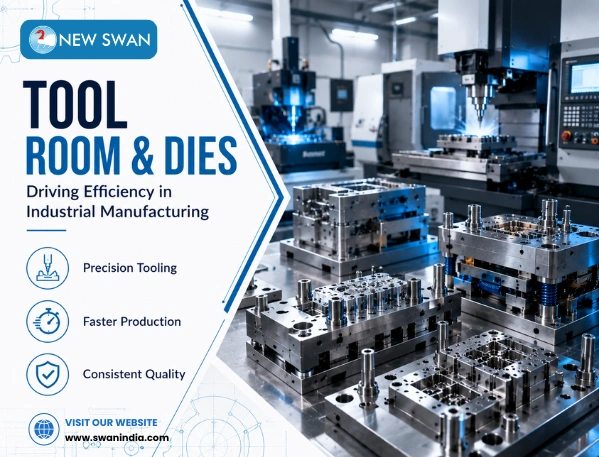

A tool room is much more than a workshop. It is the heart of a manufacturing facility where specialized tools, dies, molds, jigs, and fixtures are designed, manufactured, and maintained.
These tools are responsible for producing thousands — or even millions — of identical parts with remarkable precision. Without high-quality tooling, manufacturers would struggle to maintain product consistency and production efficiency.
An efficient tool room also supports faster product development by allowing manufacturers to create custom tooling for new projects without depending on external suppliers.
Every component manufactured today must meet strict dimensional and performance requirements. Even a minor variation can affect product functionality, assembly, or safety.
Precision tooling helps manufacturers:
These advantages make precision tooling a valuable investment for manufacturers across multiple industries.
An organized and technologically advanced tool room contributes directly to smoother manufacturing operations.
When tools are designed with accuracy, machines require fewer adjustments during production. This reduces downtime and allows manufacturers to complete projects more efficiently.
Quality tools create quality products. Accurate dies ensure every component maintains the required dimensions and finish, reducing defects and customer complaints.
Efficient tooling minimizes rejected parts, unnecessary rework, and material waste. Over time, this helps manufacturers optimize operational costs while maintaining high production standards.
Well-maintained tools place less stress on production machinery, resulting in smoother operations and improved equipment lifespan.
Precision tooling supports a wide range of manufacturing sectors.
Vehicle manufacturers require complex dies for producing chassis components, brackets, transmission parts, and various structural assemblies with exceptional accuracy.
Industrial machinery manufacturers use precision tooling to create durable components capable of operating in demanding environments.
Modern farming equipment requires accurately manufactured parts that deliver dependable performance under continuous use.
Commercial vehicle manufacturers rely on precision tooling to produce reliable components that meet strict quality and safety standards.
From sheet metal fabrication to precision machining, tooling plays a central role in producing high-quality industrial products.
Behind every successful manufacturing process is a team of experienced engineers and technicians.
They are responsible for:
Their technical knowledge ensures that tools perform consistently throughout long production runs.
Today's manufacturing facilities combine engineering expertise with advanced technology to achieve exceptional precision.
Some commonly used technologies include:
These technologies reduce manual errors while improving productivity and repeatability.
Tool manufacturing demands rigorous quality control at every stage.
Before tools are approved for production, they undergo detailed inspections, including:
This process helps ensure that production begins with tools capable of delivering reliable and consistent results.
Not every manufacturer offers the same level of tooling expertise. Selecting the right partner can have a significant impact on production quality and operational efficiency.
Consider the following factors when evaluating a supplier:
A reliable manufacturing partner not only delivers precision tooling but also provides technical support that helps improve long-term production performance.
With years of experience in precision manufacturing, Swan India has built a reputation for delivering reliable engineering solutions for diverse industries. The company focuses on advanced manufacturing practices, quality-driven processes, and continuous innovation to meet evolving customer requirements.
By combining technical expertise with modern infrastructure Swan India supports businesses in achieving consistent production quality, improved operational efficiency, and dependable manufacturing performance across a wide range of industrial applications.
Manufacturing is becoming smarter with automation, robotics, and data-driven production systems. As these technologies continue to evolve, precision tooling will remain a critical factor in achieving higher productivity and maintaining quality standards.
Manufacturers are increasingly investing in digital design, simulation software, and automated inspection systems to develop more accurate and durable tooling solutions. These advancements help reduce production time, improve efficiency, and support sustainable manufacturing practices.
Companies that continuously upgrade their tooling capabilities are better positioned to adapt to changing market demands and deliver products that meet global expectations.
The success of any manufacturing operation depends on the quality of its tooling. From reducing production downtime to improving product consistency, Tool Room & Dies play a vital role in enhancing manufacturing efficiency. They enable businesses to achieve greater precision, optimize resources, and maintain reliable production processes.
As industries continue to demand higher quality and faster production, investing in a Tool Room & Dies capabilities becomes an important step toward long-term growth. With experienced engineering teams, modern technology, and a commitment to quality, manufacturers can build a stronger foundation for future industrial success.