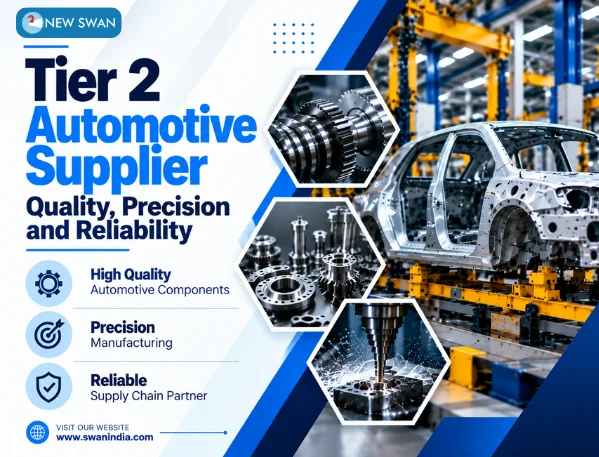

Think of it as a few layers stacked on top of each other. The vehicle maker, usually called the OEM, sits at the top and handles design, final assembly and sales. Right below are the Tier 1 companies. They build bigger systems like seats, brake assemblies or gearbox modules and deliver them straight to the assembly line.
But Tier 1 firms don't make every screw and shaft inside those systems. They buy a lot of it from the next layer down. These are the second tier companies that turn raw metal, rubber and plastic into finished components. Machined shafts, forged brackets, stamped plates, castings and fasteners all come from here. It's less glamorous work, but the whole chain leans on it.
Here's a simple example. Say a bracket costs a few rupees. If its hole is drilled a fraction of a millimetre off, it may not line up with the part next to it. The assembly team notices, the line slows down, someone has to sort the bad pieces, and a delivery might get delayed. One cheap bracket just cost the plant thousands in lost time.
This is why customers are strict with suppliers at this level. They ask for documentation, sample approvals and proof that each batch matches the drawing. It can feel like a lot of paperwork, but it exists for a good reason. Mistakes get more expensive the further they travel.
Many people picture quality as a person with a gauge checking parts at the end of the line. That's only a small piece of it. Real quality begins when the raw material arrives. If the steel isn't the right grade, no amount of careful machining will fix it later.
Good suppliers check material on arrival, watch their processes while parts are being made, and inspect again before packing. They keep records so a problem can be traced back to a specific batch, machine or shift. They also train their operators properly, because a well trained person catches small issues before they turn into scrap. None of this is exciting, but it's what separates a dependable supplier from a lucky one.
Modern engines and safety systems run on tight tolerances. When parts are slightly off, you get noise, vibration, heat or early wear, and sometimes something worse. Electric vehicles add new demands too, since they need lighter parts and better heat handling.
A CNC machine helps a lot, but the machine alone doesn't guarantee accuracy. Someone has to set it up well. The tooling has to be maintained so the thousandth part looks like the first. And the measuring equipment needs regular calibration, otherwise you're just trusting a wrong number. When all of this works together, parts fit properly the first time, and that saves everybody rework.
You can make a perfect part and still let your customer down if it arrives three days late. Many plants run on tight schedules with very little spare stock. If a component is missing, the line can stop, and a stopped line costs far more than the part ever did.
Reliable suppliers plan capacity honestly. They don't promise what they can't deliver. They hold enough raw material, they tell customers early when something changes, and they pick up the phone when a problem comes up. Buyers remember that kind of behaviour for years.
If you're a buyer comparing options, don't stop at the price quote. A few simple questions tell you a lot.
Ask how long they've worked in automotive and who their customers are. Ask what happens when a defect is found, and how fast they respond. Ask to see the shop floor if you can, because a tidy, organised plant usually reflects tidy thinking. Ask which processes they handle in house, since outsourcing too many steps can lead to delays and quality gaps.
It also helps to notice how they communicate. A supplier who answers clearly and admits their limits is usually safer than one who says yes to everything. Choosing a Tier 2 Automotive Supplier is really about choosing someone you can rely on when things go wrong, because at some point they will.
The auto sector is changing fast. Electric vehicles, lighter materials and tighter emission rules are changing what gets made and how. Suppliers who keep learning will adapt, and those who don't will slowly lose orders.
Sustainability is part of this too. More customers now ask about energy use, waste and cleaner processes during sourcing. Small improvements add up as well. A better fixture or a smarter packing method might not make headlines, but over a year it can cut cost and defects noticeably.
In the end, this business runs on trust. A customer wants to know the part they get next year will match the one they got last month. You earn that through steady work, not big promises. Companies like swanindia show what a focused manufacturer can bring to the wider automotive chain when quality, precision and reliability are treated as everyday habits rather than slogans.
Cars get the credit, but suppliers do much of the real work. Every dependable component, every on time delivery and every properly documented batch adds to the safety of the vehicle you drive. If you're building a supply chain that won't keep you up at night, a trusted Tier 2 Automotive Supplier like swanindia can be the difference between constant firefighting and steady growth.