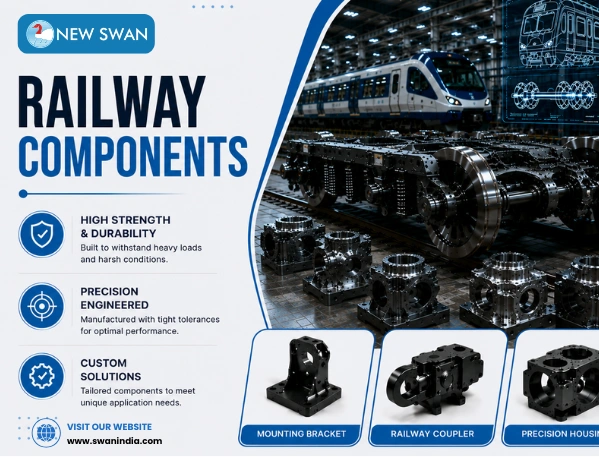

The railway industry has undergone significant transformation in recent years. Governments and private operators are investing heavily in expanding railway infrastructure, electrification projects, metro systems, and freight corridors. These developments have increased the need for precision-manufactured components that meet strict international quality standards.
Modern railway systems require parts that offer:
Every component, regardless of its size, contributes to the overall safety and efficiency of railway operations.
Railway systems consist of thousands of individual parts that perform specialised functions. These components are manufactured using advanced engineering techniques to deliver maximum reliability throughout their service life.
Some commonly manufactured railway parts include:
Each component is designed to meet precise dimensional specifications and performance requirements.
Because railways operate under demanding conditions, manufacturers follow strict quality control processes to ensure every product performs consistently.
Railway applications leave little room for manufacturing errors. Even a minor variation in dimensions can affect assembly, alignment, or operational safety.
Precision engineering offers several advantages:
Accurately manufactured parts fit perfectly within railway assemblies, reducing the possibility of mechanical failures.
Precision ensures smooth operation of moving assemblies while reducing unnecessary wear.
Quality manufacturing minimises stress concentrations, extending the lifespan of railway equipment.
Consistent production allows operators to depend on components for continuous operation with minimal interruptions.
Selecting the right material is critical for railway applications because components are exposed to varying temperatures, moisture, vibration, and heavy mechanical loads.
Commonly used materials include:
Steel provides exceptional load-bearing capacity and durability for structural applications.
Ideal for environments where corrosion resistance is required.
Offers superior strength and wear resistance for demanding operational conditions.
Lightweight yet strong, aluminium helps reduce overall vehicle weight without compromising structural integrity.
Material selection depends on the intended application, operating environment, and required performance characteristics.
Producing reliable railway components involves multiple advanced manufacturing processes.
Laser cutting, punching, bending, and forming produce complex sheet metal parts with high accuracy.
CNC machining ensures tight tolerances and consistent dimensions across production batches.
Forged components provide superior mechanical strength, making them suitable for high-load railway applications.
Advanced welding processes create durable assemblies capable of handling continuous operational stress.
Protective coatings improve corrosion resistance while enhancing the appearance and longevity of components.
Each manufacturing stage contributes to the overall quality of the finished product.
Railway manufacturers operate under strict quality requirements because component reliability directly impacts passenger safety and operational efficiency.
Quality assurance generally includes:
Advanced measuring equipment ensures every component complies with customer specifications before delivery.
Maintaining consistent quality also helps manufacturers reduce defects, minimise production waste, and improve customer satisfaction.
Choosing well-engineered components provides long-term operational advantages for railway manufacturers and operators.
Reliable parts reduce unexpected breakdowns and improve overall system availability.
Durable components require fewer replacements, helping maintenance teams reduce downtime.
High manufacturing standards contribute to safer railway operations and improved reliability.
Although quality components may involve greater engineering expertise, they often lower maintenance costs over their operational life.
Reliable manufacturing processes ensure uniformity across every production batch, simplifying assembly and replacement.
Manufacturing technology continues to evolve, enabling greater precision and production efficiency.
Modern facilities now utilise:
These technologies improve manufacturing accuracy while supporting faster production cycles and consistent product quality.
Digital quality monitoring also enables manufacturers to detect potential issues before products reach customers.
Sustainability has become an important consideration across the manufacturing industry.
Many engineering companies are implementing environmentally responsible practices such as:
These efforts help reduce environmental impact while maintaining high manufacturing standards.
Railways themselves represent one of the most energy-efficient transportation systems, making sustainable manufacturing an important part of the industry's future.
Selecting the right supplier is essential for maintaining quality, reliability, and timely project completion.
When evaluating a manufacturing partner, consider the following:
Manufacturers with experience in railway engineering understand industry-specific requirements and compliance standards.
Modern production facilities ensure precision manufacturing and consistent quality.
International certifications demonstrate commitment to quality management and continuous improvement.
Strong design and manufacturing capabilities allow suppliers to produce customised solutions for various railway applications.
Reliable production planning ensures components are delivered according to project schedules.
Working with an experienced manufacturer helps minimise production risks while supporting long-term operational success.
With decades of manufacturing expertise, Swan India has established itself as a trusted engineering and manufacturing company serving multiple industrial sectors. The company combines advanced manufacturing technologies with rigorous quality control processes to produce precision-engineered components that meet demanding customer requirements.
Its modern infrastructure, skilled engineering team, and commitment to continuous improvement enable the production of high-quality metal components suitable for diverse industrial applications. From precision machining and sheet metal fabrication to forging and assembly, Swan India focuses on delivering products that meet stringent quality expectations while supporting efficient manufacturing operations.
As railway infrastructure continues to expand worldwide, the demand for durable, precision-engineered solutions will only continue to grow. High-quality Railway Components play a crucial role in ensuring operational efficiency, passenger safety, and long-term reliability across modern railway systems. From precision manufacturing and advanced materials to rigorous quality inspection, every stage of production contributes to dependable railway performance.
Manufacturers that invest in advanced technology, skilled engineering, and consistent quality standards are better positioned to support the evolving needs of the railway industry. By partnering with experienced companies committed to excellence, railway operators and OEMs can build safer, more efficient, and more reliable transportation systems for the future.