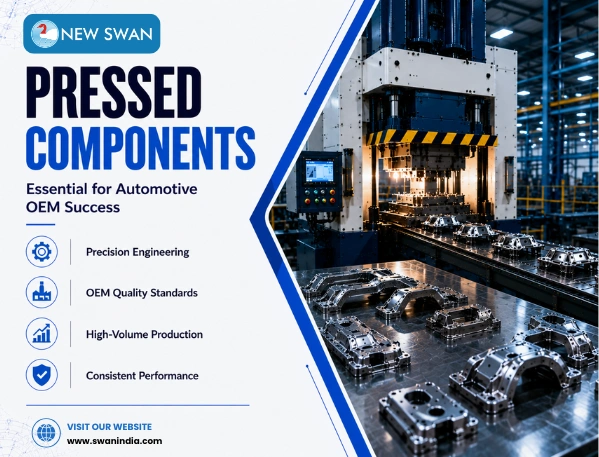

Metal pressing is a manufacturing process that transforms flat metal sheets into complex shapes using specially designed dies and high-capacity presses. This process enables the production of identical parts in large quantities while maintaining tight dimensional accuracy.
The automotive sector depends heavily on these precision-made parts because they provide structural support, secure assemblies, and improve the overall integrity of vehicles. Components manufactured through pressing are commonly used in chassis systems, engine assemblies, suspension systems, body structures, brackets, reinforcements, and numerous other applications.
The ability to manufacture these parts with exceptional repeatability makes them ideal for modern automotive production lines, where even the smallest variation can affect assembly quality.
Automotive OEMs operate in a highly competitive environment where quality and efficiency are equally important. Every supplier must consistently deliver products that meet strict specifications while supporting large-scale production schedules.
Precision manufacturing offers several advantages:
These benefits allow OEMs to reduce production delays while maintaining the quality expected in today's automotive market.
Pressed Components play a critical role in supporting modern automotive manufacturing. From structural reinforcements to mounting brackets and safety-related assemblies, these parts contribute significantly to the performance and reliability of every vehicle.
Their precision ensures accurate fitting during assembly, reducing production interruptions and improving manufacturing efficiency. Since vehicles are produced in high volumes, consistency across every component is essential for maintaining quality standards.
These components also support vehicle weight optimisation. Properly designed metal parts help manufacturers reduce unnecessary weight without compromising structural strength. Lighter vehicles often improve fuel efficiency and support evolving sustainability goals.
In addition, high-quality pressed parts provide excellent durability, allowing vehicles to perform reliably under different operating conditions over many years.
Selecting a manufacturing partner involves much more than comparing production capacity. OEMs evaluate suppliers based on several important factors that directly impact long-term business success.
Every automotive component must meet exact engineering specifications. Advanced tooling, precise die design, and modern production equipment ensure consistent accuracy throughout the manufacturing process.
Reliable inspection procedures help identify even minor variations before products reach customers. Quality management systems ensure that every batch meets the required industry standards.
Vehicle production volumes often fluctuate depending on market demand. Suppliers capable of increasing production while maintaining consistent quality become valuable long-term partners.
Experienced engineering teams can optimise product designs for manufacturability, improving efficiency while maintaining performance requirements.
Automotive production operates on carefully planned schedules. Consistent on-time delivery helps OEMs avoid costly manufacturing interruptions.
Modern manufacturing facilities use advanced machinery and automated processes to improve production quality and efficiency.
Some of the technologies commonly used include:
These technologies improve dimensional accuracy while reducing production variability.
The automotive industry follows strict international quality standards designed to ensure product consistency and safety. Suppliers must implement robust quality management systems covering every stage of production.
Important quality activities include:
Comprehensive quality systems help manufacturers deliver reliable products that meet OEM expectations.
As the automotive industry evolves, manufacturers continue developing electric vehicles, hybrid platforms, and lightweight transportation solutions. These changes increase demand for precision-engineered metal components capable of meeting new design challenges.
Lightweight materials, complex geometries, and advanced manufacturing methods are becoming increasingly important. Suppliers must continuously invest in technology and process improvements to support changing vehicle designs.
Flexible manufacturing capabilities enable suppliers to produce components suitable for both traditional and next-generation automotive platforms.
Successful automotive manufacturing depends on collaboration between OEMs and trusted suppliers. Strong partnerships create opportunities for continuous improvement, better communication, and faster problem-solving.
Long-term supplier relationships offer several advantages:
When suppliers understand an OEM's production requirements, they can proactively support future growth and changing market demands.
Years of manufacturing experience provide valuable knowledge that cannot be replaced by machinery alone. Experienced manufacturers understand material behaviour, tooling optimisation, production efficiency, and quality assurance.
This expertise helps minimise production challenges while improving product performance and manufacturing consistency.
For complex automotive applications, practical engineering knowledge often becomes a competitive advantage that supports successful project execution.
Finding the right supplier requires careful evaluation of multiple factors beyond production capacity.
OEMs should consider:
A supplier demonstrating excellence across these areas is more likely to become a valuable strategic partner.
Swan India has established itself as a reliable manufacturing partner by focusing on engineering excellence, precision production, and consistent quality. With advanced manufacturing capabilities and a commitment to continuous improvement, the company supports automotive customers with dependable solutions designed to meet demanding industry requirements.
By investing in modern technologies, skilled professionals, and stringent quality processes, Swan India helps customers achieve greater manufacturing efficiency while maintaining high standards across every production stage.
The success of every automotive OEM depends on reliable suppliers capable of delivering precision-engineered components with consistent quality. High-performance manufacturing not only supports efficient vehicle assembly but also contributes to safety, durability, and long-term customer satisfaction.
As automotive technologies continue to evolve, manufacturers require partners who combine engineering expertise with advanced production capabilities and dependable quality systems. Pressed Components remain a vital part of this manufacturing ecosystem, enabling OEMs to produce vehicles that meet global expectations for performance, reliability, and innovation. Choosing the right manufacturing partner ultimately strengthens the entire supply chain and supports sustainable growth in an increasingly competitive automotive industry.