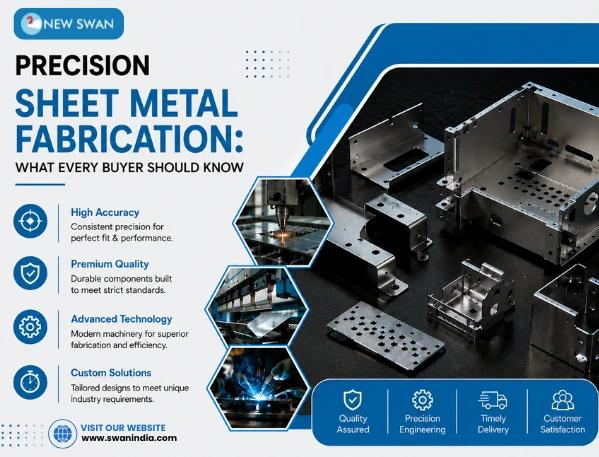

Sheet metal fabrication is a manufacturing process that transforms flat metal sheets into finished parts and components through techniques such as cutting, bending, punching, welding, and assembling. Modern manufacturing facilities rely on advanced machinery, computer-aided design (CAD), and automated systems to achieve consistent accuracy and repeatability.
The choice of material also plays an important role in the fabrication process. Common materials include stainless steel, mild steel, aluminum, copper, and galvanized steel. Each material offers unique properties, making it suitable for different industrial applications. Selecting the right material depends on factors such as strength requirements, corrosion resistance, weight, and budget.
Quality is one of the most important considerations when purchasing fabricated metal components. Poor workmanship can lead to dimensional inaccuracies, weak welds, premature failures, and increased maintenance costs. High-quality fabrication ensures that every component meets the required specifications while maintaining structural integrity and long service life.
Reliable manufacturers implement strict quality control measures throughout the production cycle. They inspect raw materials, monitor machining processes, verify dimensions, and perform final inspections before shipment. These practices help minimize defects and deliver products that meet customer expectations.
Finding the right fabrication company involves more than comparing prices. Buyers should carefully evaluate several factors before making a decision.
A dependable manufacturer should offer a wide range of fabrication services under one roof. These may include:
Working with a company that provides complete manufacturing solutions reduces coordination challenges and shortens production timelines.
Modern equipment directly impacts product accuracy and consistency. Manufacturers that invest in CNC machines, automated laser cutting systems, robotic welding, and advanced inspection tools are better positioned to produce complex components with tight tolerances.
Advanced technology also improves production speed while minimizing material waste.
Experience often reflects a manufacturer's ability to handle challenging projects. Companies that have worked across multiple industries understand different engineering requirements and compliance standards.
Reviewing previous projects, certifications, and client testimonials can provide valuable insights into a supplier's capabilities.
Every project has unique material requirements. Selecting the wrong metal can increase costs or reduce product performance.
For example:
Discussing material options with your fabrication partner ensures that your components meet both functional and budgetary requirements.
Many industries require components that fit perfectly during assembly. Even small dimensional errors can create production delays, increase rejection rates, and affect product performance.
This is where Precision Sheet Metal Fabrication becomes especially valuable. Advanced manufacturing techniques ensure every part is produced according to exact engineering drawings, reducing variations and improving overall production efficiency.
Consistent dimensional accuracy also simplifies large-scale manufacturing by ensuring that every component remains interchangeable.
Before selecting a fabrication partner, buyers should ask several important questions:
These questions help determine whether a supplier can meet current and future manufacturing requirements.
Many businesses require components designed specifically for their products. Custom fabrication allows manufacturers to produce unique parts according to customer drawings and technical specifications.
Custom solutions offer several advantages:
Partnering with an experienced fabrication company makes it easier to transform engineering concepts into production-ready components.
Many purchasing decisions focus solely on price, but the lowest quote does not always provide the best value.
Some common mistakes include:
Avoiding these mistakes can reduce production risks and improve long-term operational efficiency.
Successful manufacturers often work with the same fabrication partners for years. Strong supplier relationships lead to better communication, faster project execution, consistent product quality, and improved cost management.
An experienced manufacturing partner also becomes familiar with your product requirements, making future production runs more efficient.
Companies like Swan India understand that long-term partnerships are built on quality, reliability, transparent communication, and timely delivery. By focusing on customer satisfaction and continuous improvement, they help businesses maintain consistent manufacturing standards while meeting evolving industry demands.
Selecting the right fabrication partner is an important business decision that affects product quality, production efficiency, and overall operational success. Rather than choosing a supplier based solely on pricing, buyers should evaluate manufacturing capabilities, quality control processes, technical expertise, equipment, and customer support.
When these factors are carefully considered, businesses can confidently invest in Precision Sheet Metal Fabrication solutions that deliver reliable, accurate, and durable components for a wide range of industrial applications. Working with trusted manufacturers such as Swan India provides the confidence that every project is handled with professionalism, advanced technology, and a commitment to delivering exceptional results.