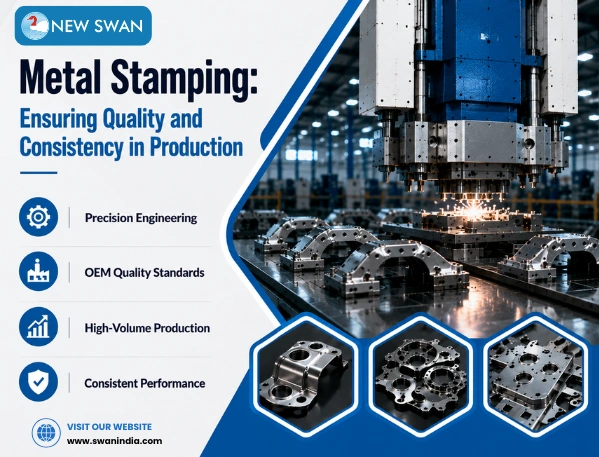

Metal Stamping is a precision manufacturing process used to transform flat metal sheets into complex shapes using specially designed dies and high-performance presses. Depending on the component design, the process may include operations such as blanking, punching, bending, embossing, piercing, coining, and forming.
Manufacturers use this process to produce components from a variety of materials, including:
Because the process offers exceptional repeatability and production speed, it has become one of the most widely used manufacturing methods for high-volume industrial applications.
Every manufactured product is only as reliable as the components used to build it. Whether it is a vehicle chassis, engine assembly, agricultural equipment, or industrial machine, every part must fit precisely and perform consistently throughout its service life.
Maintaining quality in manufacturing helps businesses achieve:
Consistent quality is particularly important in industries where a single component can directly influence the performance of the final product.
Achieving consistent production is not the result of one machine or one inspection. It requires complete control over every stage of manufacturing.
Successful manufacturers establish standardised production processes that ensure every component is produced under carefully monitored conditions. This includes controlling material quality, machine settings, tooling accuracy, production speed, and inspection procedures.
When every stage follows defined quality parameters, manufacturers can produce thousands of identical parts without compromising precision.
The quality of any stamped component begins with the tooling.
Precision dies determine the exact dimensions, shape, and finish of every component produced. Even the most advanced press cannot deliver consistent results if the tooling is poorly designed or improperly maintained.
High-quality tooling offers several advantages:
Regular maintenance and calibration ensure that tooling continues to perform accurately even during high-volume manufacturing.
No manufacturing process can compensate for poor-quality raw materials.
Reliable manufacturers carefully inspect incoming metal sheets before production begins. Every batch is evaluated to ensure it meets required specifications for thickness, strength, hardness, and surface quality.
Choosing premium-grade materials contributes to:
Material verification forms the first step in building quality into the manufacturing process.
Modern stamping facilities combine powerful presses with advanced automation systems to improve productivity while maintaining consistent quality.
Today's manufacturing equipment provides:
Automation also helps minimise human error, allowing manufacturers to maintain tight tolerances even during continuous production.
Quality cannot be achieved through final inspection alone. It must be integrated throughout the entire production cycle.
Leading manufacturers implement multiple inspection stages to ensure every component meets customer specifications.
Raw materials are thoroughly checked before entering production to verify mechanical properties and dimensional consistency.
Operators continuously monitor production to identify any deviations before they affect large production batches.
Critical dimensions are verified using advanced inspection equipment such as:
These inspections ensure every component remains within specified tolerances.
Before dispatch, finished products undergo comprehensive inspection for dimensions, surface finish, structural integrity, and overall compliance with customer requirements.
This layered quality approach significantly reduces the possibility of defects reaching customers.
The versatility of stamped components makes them indispensable across numerous industries.
Vehicle manufacturers rely on precision components for:
Consistent manufacturing directly contributes to vehicle safety and performance.
Agricultural equipment operates in demanding environments, making durable and accurately manufactured metal components essential for long-term reliability.
Heavy machinery depends on precision-engineered components that can withstand continuous operation under challenging conditions.
Stamped metal parts are widely used in electrical panels, enclosures, connectors, terminals, and industrial assemblies where precision is critical.
Manufacturers today are expected to improve efficiency while reducing environmental impact.
Modern production facilities adopt sustainable practices such as:
These initiatives help conserve resources while supporting responsible industrial growth.
Selecting a manufacturing partner involves much more than evaluating production capacity.
Businesses should look for companies that offer:
A dependable manufacturing partner becomes an extension of your own production process, helping maintain product quality and customer satisfaction.
With decades of experience in precision engineering, Swan India has built a reputation for manufacturing high-quality automotive and industrial components that meet global expectations. The company combines advanced manufacturing technology, precision tooling, experienced engineers, and stringent quality management systems to deliver reliable products across diverse industries.
Every stage of production — from tooling development and material inspection to manufacturing and final quality verification — is managed with a strong focus on accuracy, consistency, and performance. This commitment enables Swan India to support OEMs and industrial customers with components that deliver long-term reliability and dependable performance.
In an industry where precision directly impacts performance, maintaining quality and consistency is essential for long-term success. Metal Stamping remains one of the most effective manufacturing processes for producing high-volume, precision-engineered components that meet demanding industry standards.
By combining advanced machinery, precision tooling, premium materials, skilled engineering, and comprehensive quality assurance, manufacturers can consistently produce components that exceed customer expectations. Businesses that choose experienced partners with a proven commitment to excellence gain more than reliable components—they gain confidence in every product they manufacture. With this focus on precision and continuous improvement, manufacturers are well positioned to meet the evolving demands of global industries while delivering exceptional value and lasting performance.