
Every part on a vehicle is connected to something else, which sounds obvious until you watch what happens when one piece doesn't fit right. Suddenly there's rework, delays, and a supervisor asking uncomfortable questions. OEMs ordering thousands of identical parts a month don't have room for that kind of inconsistency, and honestly, neither do their suppliers if they want repeat business.
This is where automated cutting has a real edge over manual fabrication. Human hands get tired, machines don't. Once a cutting path is programmed, the two-thousandth part looks the same as the first one. For manufacturers working across stainless steel, mild steel, and aluminum alloys, that consistency is often the difference between a long-term contract and a one-time order.
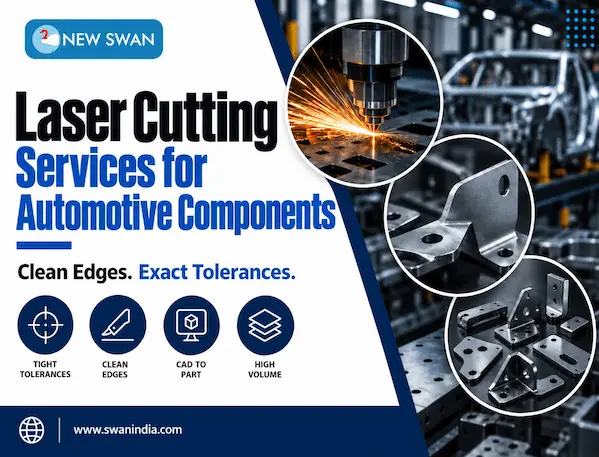
The concept is simpler than the machinery makes it look. A beam hits the metal sheet, the heat melts or vaporizes material along a path, and because that path comes from a digital file, there's no need for separate physical molds every time a design changes. You go from CAD (Computer-Aided Design) drawing to the finished part without much in between.
That matters a lot for parts with curves, odd angles, or tight hole patterns, which automotive components tend to have more often than you'd think. Traditional stamping usually needs new tooling for every design tweak, and tooling isn't cheap or fast. Skip that step and you shave real time off product development, especially when a new vehicle model is on a tight launch schedule.
Automotive parts rarely come from just one type of metal. Depending on what the part needs to do, manufacturers typically reach for:
Mild steel, mostly for brackets and mounting hardware where cost and strength both matter Stainless steel, especially anywhere near heat or moisture, like exhaust-adjacent components Aluminum alloys, increasingly common now that weight reduction has become a bigger priority, particularly for EVs chasing better range
Each of these behaves a little differently under a cutting beam. Speed, intensity, even the angle can need adjusting depending on the material. Manufacturers who've been doing this a while tend to know these adjustments almost instinctively, which is honestly part of what separates an experienced shop from a newer one.
Cutting technology touches more of the automotive supply chain than people usually realize. A few common examples:
Sheet metal brackets and mounting plates used inside vehicle frames and engine bays Exhaust clamps and fittings that need edges clean enough to avoid leaks or fitment issues Truck and trailer body parts, where strength and dimensional accuracy both matter Structural components for construction equipment, which often share the same production lines as automotive parts
Because volumes tend to be high, even small accuracy improvements add up fast across a production run. That's really why manufacturers keep upgrading their cutting equipment instead of sticking with whatever worked a decade ago.
Precision on a single part doesn't mean much if it can't be repeated across a batch of ten thousand. The manufacturers who get this right usually pair good equipment with genuine quality control, meaning dimensional checks, material certification, and someone actually looking at parts for surface defects, not just trusting the machine blindly.
This matters even more for manufacturers exporting internationally, since overseas buyers tend to have stricter compliance expectations. Suppliers who can prove consistency, order after order, are usually the ones who end up with long-term contracts instead of scattered one-off orders.
Documentation is part of this too, and it's easy to underestimate. Buyers increasingly want traceability records, material certificates, and inspection reports alongside the physical shipment, especially once parts start crossing borders. Manufacturers who build these checks into their day-to-day process, rather than scrambling for paperwork after the fact, tend to run into far fewer disputes later on.
Swan India has shaped its manufacturing approach around exactly this kind of consistency, supplying precision components to well-known names across two-wheelers, commercial vehicles, and construction equipment. Their experience spans multiple product lines, from sheet metal parts to fine blanking and forged components, which reflects a broader shift in the industry toward manufacturers who can handle the full picture rather than just one process in isolation.
For OEMs and tier-1 suppliers, choosing a manufacturing partner is rarely just about who quotes the lowest price. Buyers tend to weigh a handful of things before signing on:
Manufacturing capability, meaning the range of materials and part complexity a supplier can actually handle without excuses Quality track record with similar automotive clients, not just claims on a brochure Production capacity, including whether they can scale up when demand suddenly spikes Turnaround time, both for prototypes and full production runs
A supplier that checks all four boxes takes a lot of risk off the buyer's plate, which matters more in automotive than in most other industries. That's probably why so many long-term supply relationships get built slowly, over several smaller projects, rather than handed out on the first meeting.
Vehicles keep getting more complex, and manufacturing timelines keep getting tighter, which means precision cutting isn't really optional anymore. It's become part of the baseline. Laser Cutting in particular gives manufacturers the flexibility to work across different materials and part designs while still hitting the tolerances OEMs expect without compromise.
If you're evaluating automotive component suppliers, it's worth paying attention to whether they actually understand both the technical and quality side of this process, not just one or the other. Swan India continues to serve that need through its broad manufacturing capabilities and relationships built over years with automotive brands across India and international markets.