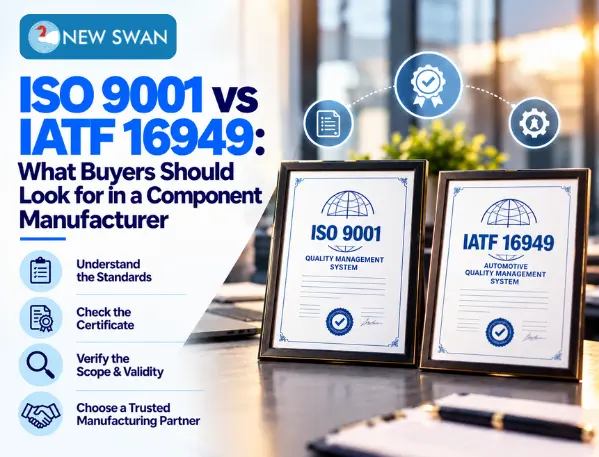

Put simply, ISO 9001 says a company has a good system. IATF 16949 says it has a good system built for automotive, with proof to back it up. A faulty bracket on a truck is a bigger deal than a faulty box on a shelf, so vehicle makers ask for the second one far more often. Other industrial buyers are usually fine with the first.
So which one do you need? If you supply a vehicle maker or one of their direct suppliers, check their requirements before anything else. If you work in construction equipment, general engineering or the aftermarket, ISO 9001 is normally enough, though extra automotive style discipline never hurts. And if you export, ask your overseas customer. Some markets are fussy about certificates.
Anyone can paste a badge on a website. A genuine ISO Certified Manufacturer won't mind you asking for proof. Here's what to check.
Get a copy of the certificate. Look at the company name, address, standard and expiry date. Read the scope. Does it actually cover forging, machining or whatever you're buying? See who issued it. The certification body should be accredited, and for IATF 16949 it should be recognised by the IATF. Confirm the site. Certificates belong to particular locations, so your parts should be made at the certified one. Ask for real paperwork, like inspection reports and material test certificates.
For important parts, go and see the plant, or at least ask for a video walkthrough. Five minutes on a shop floor tells you more than a stack of PDFs.
A certificate tells you a system exists. It doesn't tell you whether people follow it on a busy Tuesday afternoon when orders are piling up.
Some signs are easy to spot. The supplier has its own inspection equipment. They can trace a batch back to its raw material. Deliveries turn up when promised. When you ask a technical question, you get a straight answer instead of a sales line. Watch how a supplier talks about mistakes too. Every factory slips up now and then. The good ones will tell you what went wrong, what they changed and how they'll stop it happening again. At Swan India we'd rather you ask those awkward questions up front, and we're happy to answer them.
Not always, and an honest supplier will tell you so. Stricter certification usually means more paperwork, more checks and more audits behind the scenes, and that can show up in the price. If you're ordering a simple part for a low risk job, ISO 9001 with solid inspection records may be perfectly fine. If the part sits in a braking system, a steering assembly or anywhere else a failure could hurt someone, the tighter controls are worth paying for. Match the standard to the risk, not to whichever badge sounds most impressive.
One more small habit that pays off. Certificates run on a cycle and they do expire, so ask for an updated copy once a year. It takes a minute and saves you a nasty surprise later.
ISO 9001 and IATF 16949 aren't the same thing. One shows a well run company. The other shows a company that has taken on the tougher rules of the automotive world. Pick the one that fits your job, check the paperwork, and then judge how quality works on the floor.
Above all, find an ISO Certified Manufacturer who is easy to talk to and honest when things go wrong. That kind of supplier ends up being a partner, not just a name on a purchase order.
If you've got forged, machined or sheet metal parts to source, send your drawings and quantities to Swan India and we'll come back with a straight review.