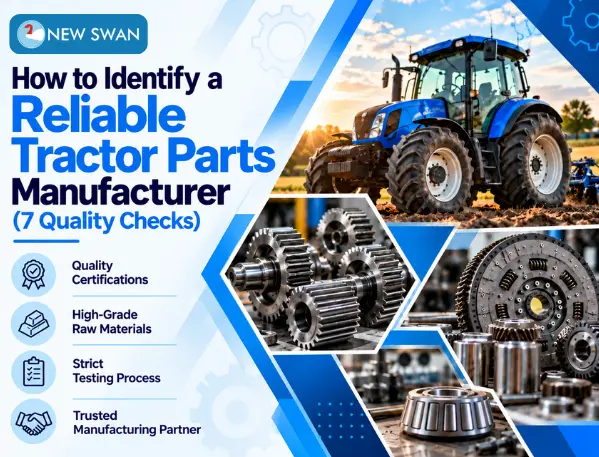

Start with the paperwork. A serious manufacturer will hold quality certifications such as ISO 9001, and many also follow industry standards for agricultural machinery. Ask to see the certificates and check that they are still valid. A reliable company will be happy to share them. If they dodge the question or send outdated documents, take that as a warning sign.
Nothing tells you more than seeing the place where parts are actually made. Look at the machinery, the cleanliness of the shop floor and how well the stores are organised. If a visit is not possible, ask for a video walkthrough. Modern CNC machines, well maintained tools and trained operators usually point to a company that cares about precision and consistency.
Good parts begin with good metal. Ask what grade of steel, cast iron or alloy is used for each part and where it comes from. A trustworthy manufacturer will explain their material choices openly and provide material test reports when you ask. Cheap or recycled metal may save a little money at first, but it wears out quickly and can damage other components in your tractor.
Quality cannot be added at the very end. It has to be checked at every stage of production. Ask about hardness testing, dimensional inspection, pressure testing for hydraulic parts and fatigue testing for gears and shafts. Find out whether every batch is tested or only a few random samples. The more detail they give you, the more confident you can feel about what lands on your shelf.
Take a sample part and compare it with the original equipment version. Check the measurements, surface finish, weight and markings. Parts that fit loosely, look rough or feel lighter than expected are often made with shortcuts. Real precision shows in small details like clean threads, smooth edges and even machining. Your hands and eyes can catch problems that a brochure will never mention.
A manufacturer who stands behind their work will offer a clear warranty. Read the terms carefully. Find out how claims are handled, how quickly they respond and whether replacements are easy to get. Good support also means helping you with technical questions, part numbers and compatibility. If a seller becomes hard to reach once the payment is made, you already have your answer.
Finally, look at how long the company has been in business and who else buys from them. Ask for references from dealers or other customers and speak to them directly. Read online reviews, but also talk to people in your own network. A manufacturer with years of steady supply and plenty of repeat customers has usually earned that trust honestly.
Everyone likes a good deal, but the lowest quote is rarely the best value. A part that costs 20 percent less but fails twice as fast will cost you more in the long run. Add the cost of labour, downtime and damaged machinery and the savings disappear quickly. Instead of chasing the cheapest price, compare the total value, which includes durability, warranty and service. Reliable manufacturers price their parts fairly because they invest in materials, testing and skilled people.
Over time, a few patterns tend to show up with unreliable suppliers. They avoid sharing certificates or test reports. They cannot explain which materials they use. They refuse to provide samples before a bulk order. Their packaging is poor and part markings are unclear. They promise unrealistic delivery times or prices that sound too good to be true. Any one of these might be an honest mistake, but several together usually mean you should look elsewhere.
At Swan India, quality is not treated as a final inspection step. It is built into the process from the moment raw material arrives. Every batch goes through dimensional and material checks, and parts are compared against OEM specifications before they are packed. The team also stays close to dealers and customers, which means feedback from the field quickly turns into improvements on the shop floor. That kind of openness is exactly what you should expect from any supplier you plan to work with for the long term.
Choosing the right Tractor Parts Manufacturer takes a little effort up front, but it pays off every season. Check certifications, see the facility, ask about materials, understand the testing, compare against OEM standards, review the warranty and study the track record. If a supplier passes all seven checks, you can buy with confidence. Reliable parts keep tractors working, and working tractors keep farms running. If you are looking for a partner who takes that responsibility seriously, Swan India is ready to talk about your requirements and show you what dependable manufacturing looks like.