
Most people start their search by comparing prices. And look, cost matters, nobody is denying that. But if you only chase the lowest quote, you might end up paying for it later in ways that are harder to fix. A component that fails after a few months in the field doesn't just cost you a replacement. It costs you customer trust, which is a lot harder to earn back.
A good manufacturer isn't just someone who ships you parts on time. They understand your product, they know the safety requirements inside out, and honestly, they should feel more like a technical partner than a vendor. That's really the mindset shift most businesses need to make before they even start comparing options.
Here's something a lot of first time founders miss. Not every manufacturer does everything well. One company might be great with motors but average with batteries. Another might be a battery specialist but has never touched a charging system. Before you even ask for a quote, figure out what your product actually needs and check if that's their bread and butter or just something they dabble in.
Look for relevant quality certifications, testing capabilities, and regulatory compliance. Depending on the component and vehicle application, specific standards and regulatory requirements may apply. ISO certification can also indicate that a manufacturer follows a structured quality-management system.
This one gets overlooked a lot. Your first order might be small, sure, but what happens six months from now when demand doubles? Ask upfront about production capacity and whether they can scale with you. A manufacturer who can barely keep up with your pilot order is going to struggle badly once you start scaling.
If you're a startup or a smaller brand still testing the waters, rigid MOQs can be a dealbreaker. Some manufacturers only want to work in bulk, which just doesn't make sense for a business still finding its footing. Ask about this early so you don't waste weeks negotiating something that was never going to work for your size.
Location sounds like a minor detail until it isn't. Manufacturers based in industrial hubs like Chakan, Sanand, or Oragadam usually have better access to raw materials and a skilled workforce nearby. That translates into fewer delays and lower shipping costs for you, which adds up over time more than people expect.
Things go wrong sometimes, even with great quality control. What really separates a good manufacturer from a mediocre one is how they handle it when it does. Ask about warranty terms and how fast their support team actually responds, not just what's written in the contract.
This one is easy to ignore until it bites you. A manufacturer struggling financially might delay payments to their own suppliers, which eventually trickles down to delays for you too. It's worth doing a bit of digging here before you commit to a long term relationship.
Even if you're only selling domestically right now, think a few steps ahead. If international expansion is even a small possibility down the road, working with someone who already understands export compliance will save you a massive headache later.
Chasing the cheapest quote without checking certifications is probably the most common one. Right behind that is never actually visiting the manufacturing facility and just trusting whatever the sales team tells you over a call. And then there's skipping sample testing before placing a full order, which honestly baffles me every time I hear about it happening.
None of these mistakes are huge on their own, but together they can quietly derail an entire product launch.
At Swan India, we've noticed that every EV brand comes in with a slightly different problem to solve. Some need help with motor design, others are focused on battery integration, and some just need someone reliable for powertrain components. Rather than pushing a one size fits all solution, we try to match what a client actually needs with the right specialisation on our end.
That kind of fit matters more than people realise, and it's honestly what Swan India tries to get right every single time a new client comes on board.
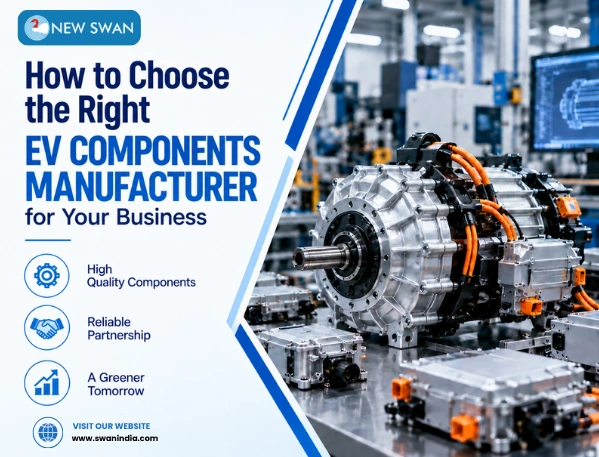
An EV components Manufacturer designs, develops, and produces parts used in electric vehicles. Depending on its capabilities, a manufacturer may produce components for electric powertrains, batteries, charging systems, vehicle structures, thermal management, and other automotive applications.
Start by evaluating the manufacturer's product expertise, quality-control processes, certifications, production capacity, customization capabilities, delivery timelines, and after-sales support. It is also important to review samples, manufacturing capabilities, and previous industry experience before placing a large order.
Electric vehicles use a wide range of specialized components, including motor and powertrain parts, battery-related components, charging-system components, thermal-management parts, structural components, and precision-engineered automotive parts. The components required depend on the vehicle's design and application.
The relevant certifications and regulatory requirements depend on the type of component being manufactured and its intended application. Businesses should look for appropriate quality-management certifications, testing capabilities, and compliance with applicable automotive and EV standards.
Yes, many manufacturers can develop customized components based on a customer's drawings, specifications, material requirements, dimensions, and production needs. Before choosing a supplier, confirm whether they have the engineering, tooling, prototyping, and manufacturing capabilities required for your particular component.
Choosing the right EV components Manufacturer isn't something you should rush through just to check it off your list. It's genuinely one of the decisions that shapes how your product performs and how your business grows over the next few years.
Take your time with specialisation, certifications, capacity, location, and support before signing anything. Get this right and you'll thank yourself later. Get it wrong and you'll be dealing with the consequences a lot longer than you'd like.