
Every project is a bit different, but most go through the same five stages. It starts with sharing your requirements. You send over drawings, material details, quantities and the quality standards you expect. A good manufacturer will read everything carefully and ask questions when something isn't clear.
Next comes the quote and the agreement. You get a price and a delivery timeline, and once you're both happy, you sign a contract. This usually covers pricing, quality and how your designs will be protected.
Then there are samples. A few trial parts get made so you can test them. It's much cheaper to fix a problem now than after thousands of pieces are done. Once you approve the samples, production begins. Parts get checked along the way so the last piece looks and performs just like the first.
Finally, everything is packed and delivered. The good ones don't disappear after that either. They stay in touch in case you need changes or want to reorder.
There isn't just one model. Build to print is the most common. You give a complete design and the manufacturer makes it exactly as drawn. With OEM manufacturing, the parts are made for you and sold under your brand. ODM is a bit different because the manufacturer helps with the design too. A private label means a ready-made product carries your name. And turnkey covers the whole thing, from design right through to delivery, so you barely have to lift a finger.
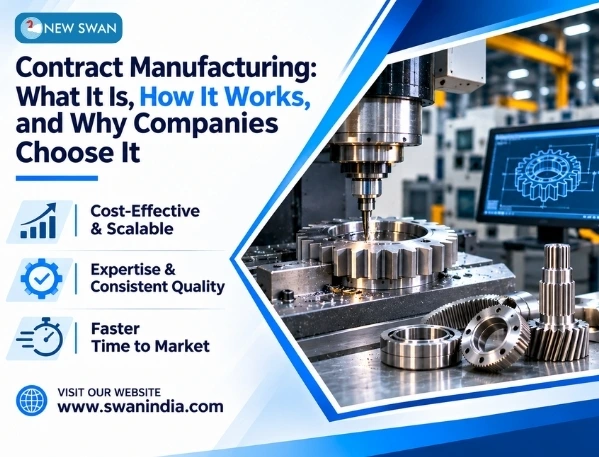
Money is the big one. Machines are expensive, factories are expensive and skilled workers aren't cheap either. With a partner, you only pay for what you actually need. That's a big reason Contract Manufacturing keeps growing everywhere.
Skills matter just as much. A specialist manufacturer has spent years fine-tuning its machines and training its team. You get all that experience without having to build it yourself.
Speed is another plus. The factory is already running, so going from drawing to finished part takes far less time. There's flexibility too. If orders jump, your partner can scale up. If things slow down, you're not stuck paying for idle machines.
And maybe the best part is focus. You can spend your time on design, sales and customers instead of worrying about shift plans and machine repairs.
Lots of industries. Automotive is the biggest, with parts like shafts, gears, brackets and suspension components. Tractor and farm equipment makers rely on it too. So do heavy engineering, oil and gas and electronics companies. If a business needs precise parts in steady numbers, this model can work for it.
Of course. Nothing is perfect, and it's better to know the risks upfront. Some people worry their design could be copied. A proper confidentiality agreement handles most of that. Others fear quality will slip over time. The fix is to choose a partner with real testing facilities and ask for inspection reports on a regular basis. And then there's communication. If a team takes days to reply, that's a red flag, so pick one that keeps you in the loop.
This is the step that matters most, so take your time.
Look at certifications first. IATF 16949 and ISO 9001 tell you the company follows a proper quality system. Then check what they can do in-house. Machining, testing and inspection under one roof means fewer delays. Ask about their experience too. A team that has worked with automotive and industrial clients will pick up your needs faster.
If you can, visit the factory. Seeing it in person tells you more than any brochure. And don't forget to ask about capacity and lead times, both for today's orders and for when you grow.
If you're searching for a dependable partner, Swan India makes precision components for automotive and industrial customers. Their focus is steady quality, honest communication and on-time delivery. You can look through their capabilities on the Swan India website, or just send your drawings and ask for a quote.
Contract Manufacturing lets you grow without carrying the weight of a factory. You get skilled people, proper machines and consistent quality, and you stay free to do what you do best. Pick a partner who's open, certified and experienced, and the rest gets a lot easier. Got a drawing ready? Then it might be time to start that conversation.