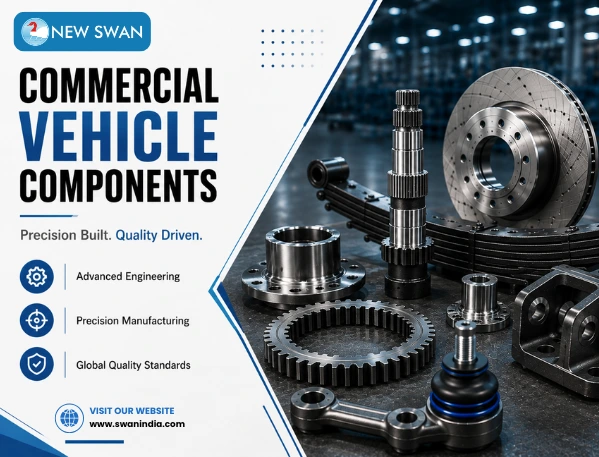

Commercial vehicles are designed to cover thousands of kilometers while carrying heavy loads in varying road and weather conditions. Every journey places continuous stress on critical systems, making component quality essential for long-term reliability.
Poor-quality parts may initially reduce procurement costs, but they often result in premature wear, frequent repairs, and increased downtime. These issues not only raise maintenance expenses but also affect delivery schedules, customer satisfaction, and overall business productivity.
Premium components, on the other hand, provide lasting value by improving vehicle stability, reducing repair frequency, and ensuring dependable performance throughout the vehicle's operating life.
Every commercial vehicle consists of numerous precision-engineered parts working together as a complete system. The efficiency of one component directly influences the performance of others, making overall quality essential.
Some of the most critical systems include:
When each component is manufactured to exact specifications, the entire vehicle operates more efficiently and safely.
Modern automotive manufacturing relies heavily on precision engineering. Tight dimensional tolerances, accurate machining, and advanced inspection processes ensure that every component performs exactly as intended.
Leading manufacturers invest in technologies such as:
These technologies reduce production variations while improving consistency across high-volume manufacturing.
The lifespan of any commercial vehicle component depends largely on the materials used during production.
Manufacturers carefully select materials capable of withstanding:
High-strength steel, alloy steel, stainless steel, engineered rubber, and specialized metal alloys are commonly used because of their exceptional strength and durability.
Selecting premium raw materials helps components maintain structural integrity even under the toughest operating environments.
Fleet operators understand that maintenance costs directly affect profitability. Frequent component replacement not only increases repair expenses but also reduces vehicle availability.
Well-engineered parts offer several financial advantages:
These benefits contribute significantly to reducing the total cost of ownership over the life of the vehicle.
Safety is one of the most important priorities in commercial transportation. Reliable components contribute to stable handling, responsive braking, and dependable vehicle control, protecting drivers, cargo, and other road users.
Manufacturers maintain rigorous quality standards by performing:
These inspections ensure every component meets strict performance and safety requirements before reaching customers.
Selecting a component manufacturer requires careful evaluation beyond pricing alone. A reliable supplier should demonstrate technical expertise, production capacity, and a strong commitment to quality.
Key factors to consider include:
Manufacturers with extensive automotive experience understand OEM requirements and international quality standards.
Modern production facilities equipped with automated machinery improve efficiency while maintaining consistent product quality.
Recognized certifications such as IATF 16949 and ISO standards indicate a structured quality management system and continuous process improvement.
An experienced engineering team can develop customized solutions that meet specific vehicle designs and application requirements.
Timely deliveries and consistent production capacity help customers maintain uninterrupted manufacturing and business operations.
Automotive manufacturing continues to evolve through automation, digital monitoring, and intelligent production systems.
Today's manufacturers leverage technologies that improve:
These advancements enable manufacturers to produce highly reliable components while meeting increasing customer expectations.
Sustainability has become an important consideration across the automotive industry. Manufacturers are adopting environmentally responsible production practices that improve efficiency while reducing environmental impact.
These initiatives include:
Sustainable manufacturing benefits both businesses and the environment while supporting long-term industry growth.
Working with an experienced manufacturing partner provides advantages that extend far beyond component supply.
Customers benefit from:
Swan India combines advanced engineering, modern manufacturing technologies, and strict quality assurance to deliver precision automotive solutions trusted by customers across domestic and international markets.
As commercial vehicles continue to become more advanced, businesses can no longer afford to compromise on component quality. Investing in durable, precision-engineered commercial vehicle components helps improve reliability, reduce maintenance costs, enhance safety, and maximize operational efficiency throughout the vehicle's lifecycle.
Choosing the right manufacturing partner ensures access to consistent quality, advanced engineering expertise, and dependable supply capabilities. High-performance commercial vehicle components are not simply parts—they are the foundation of long-term productivity, lower operating costs, and sustainable business success in an increasingly competitive transportation industry.