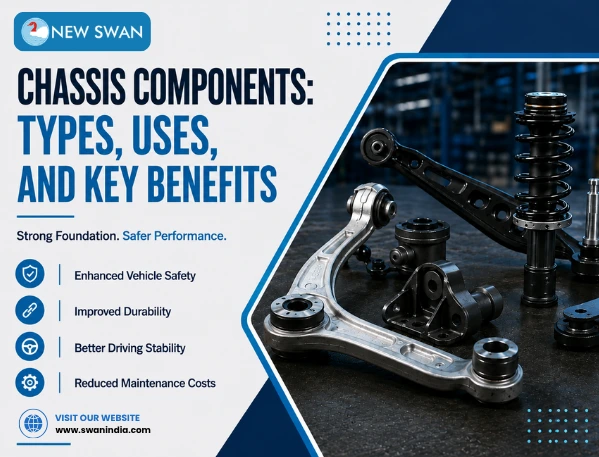

A vehicle chassis serves as the backbone of the automobile, supporting its weight while providing stability during operation. The various parts attached to the chassis work together to improve handling, maintain structural integrity, and enhance driving comfort.
High-quality Chassis Components are designed to withstand heavy loads, absorb road vibrations, and deliver consistent performance under demanding operating conditions. Modern manufacturing techniques and precision engineering have further improved their strength, reliability, and service life.
Different vehicles require different chassis configurations depending on their intended application. Some of the most commonly used chassis components include:
The suspension system helps absorb shocks from uneven road surfaces while maintaining vehicle stability. Common suspension components include control arms, leaf springs, shock absorbers, and stabilizer bars.
Steering components allow drivers to control vehicle direction with precision. These include steering knuckles, tie rods, steering arms, and steering columns.
Brake-related chassis parts provide secure mounting for braking systems and contribute to overall vehicle safety. Their durability is essential for maintaining reliable braking performance.
Cross members strengthen the chassis frame by improving rigidity and distributing loads evenly throughout the structure. They help maintain structural stability, particularly in commercial vehicles carrying heavy loads.
Various brackets are used to securely hold components such as the engine, transmission, fuel tank, and exhaust system. Properly engineered brackets improve both safety and operational efficiency.
Chassis components are widely used across multiple industries where strength, durability, and reliability are essential.
Some common applications include:
Each application requires components manufactured according to strict quality and performance standards.
Choosing premium-quality chassis parts offers several long-term advantages for manufacturers, fleet operators, and vehicle owners.
Strong and accurately manufactured chassis components improve the structural integrity of the vehicle. They help distribute forces during normal driving conditions and contribute to occupant safety by maintaining overall vehicle stability.
Vehicles often operate in challenging environments involving rough roads, heavy loads, and varying weather conditions. Durable components resist wear, corrosion, and fatigue, ensuring a longer operational lifespan.
Well-designed chassis systems improve steering response, suspension performance, and overall vehicle control. This results in smoother handling and greater driver confidence.
Reliable components require fewer replacements and repairs over time. Lower maintenance requirements help businesses reduce downtime and operating expenses.
Commercial vehicles depend on strong chassis structures to transport heavy goods safely. High-quality chassis components improve load distribution while maintaining structural strength.
Selecting the right chassis components requires careful evaluation of several factors.
The choice of raw materials significantly affects durability and performance. High-grade steel and advanced alloys provide excellent strength while resisting corrosion and mechanical wear.
Precision engineering holds the key that all individual components meet your exact dimensional tolerances. Precision machining brings a higher level of quality and provides a far easier final product to assemble ensuring reliability down the long run, especially over difficult or abrasive surfaces.
Always use parts designed and built according to industry-accepted quality standards for automotive components. A certified production process can help you assure consistent quality of components.
A knowledgeable manufacturer offers you technical knowledge, reliable quality controls, and consistent client service throughout the life cycle of the product.
Improvements in manufacturing technology have led to a revolution in the manufacturing of automotive parts. Automatic machining systems and welding robots, precision forging and stamping techniques, and sophisticated quality inspection methods enable manufacturers to produce parts that are both of high reliability and great consistency.
Chassis Components are engineered today with complex processes that enhance both accuracy and strength of dimensions and improve production efficiency of the components to satisfy requirements of the domestic and international automotive market.
Low quality chassis parts can have detrimental effects to your vehicle's performance and the cost to keep it running and safe. Inaccuracy of just small dimensions can result in parts failing early on, or fitting poorly in.
Choosing to use superior quality components allows manufacturers to ensure product consistency and reduce risk in operation. The customer ultimately benefits too, with higher satisfaction and improved long-term reliability.
Finding a trustworthy manufacturing partner matters just as much as finding the best components and materials. An experienced automotive supplier works precisely, has high quality standards and recognizes the growing demands of your vehicle production.
With modern manufacturing units, the latest production standards, quality assurance measures, high grade of parts & manufacturing practices, Swan India is equipped to manufacture robust and quality products for numerous automotive industry sectors & applications.
If you're looking for long-term reliable Chassis components, then it's worth considering how much capacity the manufactures have and what their technical strength actually is as well as quality certifications and customer support is a benefit too.
From the suspension and steering units right through to the cross members and brackets - the chassis elements make up the backbone of a vehicle's framework - on which both safety and performance are based.
Learning about the variety, functions and advantages of these elements can guide businesses towards making smarter purchases and simultaneously enhancing product quality and efficiency of the operations.
Swan India, with its precision engineering capabilities, state-of-the-art manufacturing processes, and focus on quality assurance, is well equipped to produce automotive solutions, which meet today's vehicle manufacturers ' specifications. It's a step worth taking today for tomorrow's long term performance, safety and owner satisfaction.