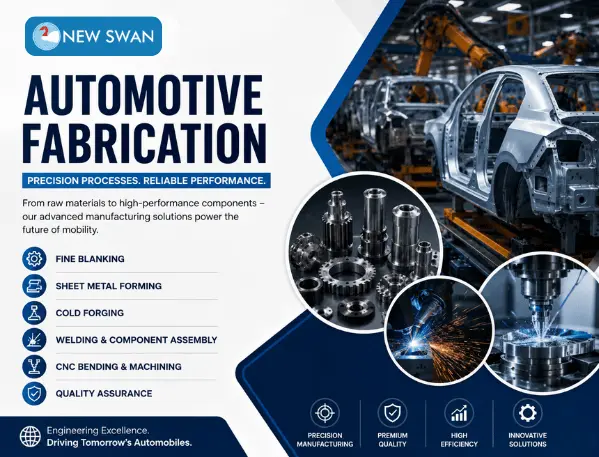

Automotive Fabrication is the metal fabrication for assembling and fitting automobile and commercial vehicle bodies through the manufacturing process to produce new shapes and joined parts. The common base material can be steel, stainless steel, aluminium, etc. And may involve other engineering materials as specified for the part depending on its use.
We choose a particular manufacturing process based on the nature of material we utilize, shape of the part, number of the components manufactured, acceptable dimensional deviations, requisite strength of the parts and so on.
A modern manufacturing facility can integrate multiple technologies to produce a component efficiently, from the initial production stage to final finishing and quality inspection. This integrated approach helps maintain consistency and reduces unnecessary movement between different suppliers.
Every vehicle component serves a specific purpose. Even a small bracket, clamp, shaft, or fastening part can play an important role in the overall performance, durability, and reliability of a larger assembly. Modern manufacturing techniques help companies achieve:
For high-volume automotive manufacturing, maintaining consistency is essential. Every component needs to meet the same specifications throughout thousands or even millions of production cycles.
Different components require different manufacturing techniques. Modern facilities generally use a combination of processes to achieve the required specifications.
Fine blanking is a precision metal-forming process used to manufacture components with precise dimensions and smooth, clean edges. It is especially suitable for applications where accuracy, quality, and consistent production are essential.
This technique can be used for components associated with transmission systems, mechanisms, brackets, and other precision applications.
Sheet metal is widely used in automotive manufacturing because it can be cut, bent, pressed, and formed into complex shapes.
The process begins with metal sheets that are transformed into components using specialized presses, dies, and forming tools. Proper tooling and process control are essential for maintaining accuracy and preventing defects.
Sheet metal manufacturing is commonly used for brackets, supports, covers, clamps, and various structural and functional components.
Cold forging involves shaping metal under high pressure without heating it to conventional forging temperatures. The process can provide excellent dimensional accuracy while making efficient use of raw material.
Steel and aluminium components can be manufactured using this technique depending on the required application. Cold-formed parts are particularly valuable where strength, precision, and repeatability are important.
Many automotive components are made up of multiple individual parts that must be securely joined together. Welding offers a strong and dependable way to permanently connect compatible metal components.
Depending on the application, manufacturers may use MIG, MAG, TIG, resistance, or robotic welding. Automated welding systems can offer greater consistency for high-volume production.
Proper welding parameters, fixtures, inspection, and process control are essential for achieving reliable joints.
CNC technology has become an important part of precision manufacturing. CNC bending machines can produce accurately shaped tubes and other components according to digital specifications.
CNC machining can also be used to manufacture complex components with tight dimensional tolerances. Computer-controlled equipment allows manufacturers to maintain consistency across large production runs.
Precision grinding may be used after machining when a component requires a particular surface finish or dimensional accuracy.
Producing a component in the required shape is only one stage of the manufacturing process. Certain components need additional treatment to develop the desired mechanical properties and performance.
Heat treatment processes can modify the hardness, strength, wear resistance, and durability of metal components.
Depending on the material and application, processes may include carburizing, carbo-nitriding, through hardening, or nitriding.
The correct heat-treatment process must be selected carefully because excessive or insufficient treatment can affect the performance of the finished component.
Automotive components may be exposed to moisture, temperature changes, chemicals, road conditions, and other environmental factors. Surface treatment can provide additional protection against corrosion and wear.
Common finishing methods include powder coating, painting, zinc-based coatings, and specialized plating processes.
Besides protecting components, surface finishing can also improve their appearance and provide specific functional properties required by the application.
Tooling plays a major role in component manufacturing. Dies, fixtures, molds, and specialized tools help manufacturers produce identical parts repeatedly.
A well-designed tool can improve production speed, dimensional accuracy, and material utilization. It can also reduce defects and simplify assembly.
Having an in-house tool room can provide manufacturers with better control over tool development, maintenance, modification, and repair. Modern equipment such as CNC machining centres, wire-cut machines, EDM equipment, grinders, and milling machines can support precision tool production.
Selecting a suitable manufacturing partner is an important decision for automotive businesses. The right supplier should be capable of meeting both current production requirements and future demand.
Here are some important factors to consider:
Check whether the manufacturer has the required processes under one production setup. Multiple capabilities can make production coordination easier.
Automotive components require consistent quality. Look for established inspection systems, testing facilities, documented processes, and relevant certifications.
Experienced engineers can help identify suitable materials, production methods, tooling requirements, and potential manufacturing challenges.
The supplier should have sufficient machinery, workforce, infrastructure, and production capacity to handle the required volumes.
Consistent delivery is critical because delays in component supply can affect vehicle assembly and overall production schedules.
Swan India has developed capabilities covering several stages of component manufacturing, including fine blanking, sheet metal components, cold forged parts, exhaust clamps, forged and machined components, and precision-machined shafts.
Its manufacturing infrastructure includes processes such as welding, CNC bending, grinding, heat treatment, tooling, and surface treatment. Having multiple processes within an integrated manufacturing environment can help improve production control and consistency.
The company also states that its automotive manufacturing journey began in 1985 and highlights its quality and environmental management certifications.
Vehicle production in the future will also focus more on the increased use of automation, precision, weight reduction and more complex designs.
Electric vehicles are bringing new demands to the automotive component manufacturing industry. As vehicle designs and architectures evolve, manufacturers must adapt their processes to produce components that meet changing requirements for weight, strength, dimensional accuracy, and overall performance.
Manufacturing plants will continue to be impacted by the ongoing rise of automation, robotics, CNC, digital inspection and further improved production monitoring capabilities.
Manufacturers that pair advanced technologies with skilled engineering will be most adept at shifting their automotive product ranges.
The process of Automotive Fabrication can not be denied and is key in the manufacturing of modern vehicle components today. Whether through processes like Fine Blanking, Sheet Metal Forming, Cold forging or Welding, or those like machining, heat treatment and surface finishing we are able to enhance quality, robustness, functionality and a high degree of reliability into any item we process.
Automotive technology is constantly evolving in today's world, so manufacturers require production partners who are able to promise high precision, consistency, quality, and consistent supply.
For businesses dealing with automotive products and wanting to streamline operations, quality in production, and develop products that satisfy tough automotive industry standards an integrated approach in manufacturing is a key solution. If you seek complete details about automotive parts and their manufacturing potential, Swan India gives you an overview of its products, processes, and infrastructure.