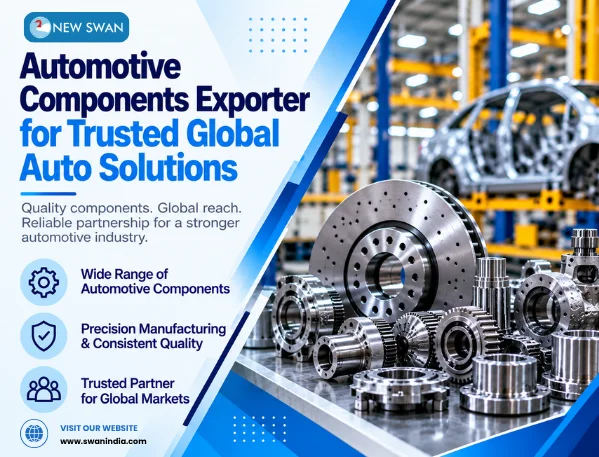

Automotive manufacturing is no longer confined to one country or region. Today, manufacturers often source components from specialized suppliers across different markets to improve production efficiency, control costs, and gain access to advanced manufacturing expertise.
For international buyers, choosing the right component supplier involves more than simply comparing prices. They also need to evaluate product quality, manufacturing capabilities, engineering support, production capacity, documentation, delivery timelines, and long-term dependability. A supplier that consistently meets these expectations becomes a valuable part of the customer's supply chain rather than just another vendor.
Automotive components are designed to perform under challenging conditions. Depending on their use, parts can be exposed to constant vibration, pressure, friction, heat, and mechanical stress. Even a minor manufacturing variation can impact assembly, durability, or the overall performance of a vehicle.
For this reason, quality must be maintained at every stage of the manufacturing process. It begins with selecting the right raw materials and continues through forming, forging, machining, welding, finishing, inspection, and final dispatch. Important quality practices include dimensional inspection, material verification, process monitoring, product testing, final inspection, traceability and documentation, and continuous process improvement. Consistent quality helps automotive manufacturers minimize production disruptions and maintain trust in their supply chain.
Today's automotive manufacturing relies on a combination of advanced technology, skilled professionals, engineering expertise, and well-controlled production processes. Different automotive components require different manufacturing techniques. Fine blanking is suitable for producing precise metal parts, while cold forging works well for components that need strength and consistent dimensions. Sheet metal forming, welding, machining, and other processes also play an important role in manufacturing automotive assemblies.
According to its official website, Swan India offers manufacturing capabilities that include fine blanking, cold forging, press shops, welding, tool rooms, sheet metal components, forged and machined parts, exhaust clamps, rubber parts, trailer parts, and precision-machined shafts. Having a wide range of capabilities enables buyers to source various types of components from a single, well-coordinated manufacturing partner.
Original Equipment Manufacturers have specific requirements for the components they source. Parts must be produced according to approved specifications, dimensional tolerances, material standards, and defined production requirements. A reliable supplier must understand these requirements and maintain consistent quality from the prototype and development stages through to regular production.
This is especially important for international buyers, as switching suppliers may require new approvals, inspections, tooling arrangements, documentation, and production validation. A dependable Automotive Components Exporter can help strengthen supply-chain stability by combining manufacturing expertise with well-organized export operations.
One of the key benefits of working with an experienced automotive component supplier is having access to a broader range of products. Depending on the manufacturing capabilities of the supplier, the product range may include fine blanking components, sheet metal parts, cold forged parts, forged and machined components, precision-machined shafts, exhaust clamps, rubber components, trailer parts, automotive assemblies, and stamping components. A diverse product portfolio can make procurement easier for buyers who require multiple categories of components.
Automotive components are not always off-the-shelf products. Many projects require parts to be manufactured according to specific customer drawings, specifications, dimensions, materials, and application requirements. Engineering support can be valuable at various stages of a project, including material selection, tooling, manufacturing process planning, dimensional control, and production optimization.
For buyers developing new components, an experienced manufacturing partner can help identify practical production methods while ensuring that the required specifications are maintained. This kind of collaboration helps build a stronger relationship between buyers and suppliers while supporting long-term business growth.
Quality is important, but it is not the only factor in global automotive supply chains. Components must also reach customers within the agreed delivery timelines. Production delays can impact assembly lines, inventory planning, aftermarket distribution, and customer commitments. For this reason, international suppliers need effective production planning, quality inspections, packaging, logistics coordination, and clear communication.
Clear communication becomes especially important when orders involve international transportation. Buyers should receive timely updates about production progress, expected dispatch dates, required documentation, and shipment status. Reliable delivery helps bring greater consistency and predictability to the supply chain.
Global buyers often prefer suppliers with established infrastructure and experience in meeting automotive requirements. Manufacturing facilities, skilled professionals, production equipment, quality systems, and technical expertise all play a role in a supplier's ability to handle larger and more complex requirements. According to Swan India's official company information, its group includes multiple companies with manufacturing facilities across northern and western India, serving OEM customers and supplying automotive components to international markets.
The international automotive business relies on consistency and trust. Buyers need suppliers that can deliver the same level of product quality across every order rather than providing dependable results only occasionally. Long-term partnerships are strengthened through consistent product quality, transparent communication, reliable production planning, technical support, accurate documentation, competitive manufacturing, continuous improvement, and timely delivery. These factors help both suppliers and buyers develop stable business relationships.
Before choosing an automotive component supplier, international buyers should consider several important factors. These include manufacturing facilities, quality certifications, production capacity, engineering expertise, product range, inspection systems, delivery capabilities, and relevant industry experience. It is also important to determine whether the supplier can support both current products and future development needs.
A supplier with a strong understanding of the complete manufacturing process can offer greater value than one focused only on producing individual parts. Effective technical coordination can reduce communication gaps and make production planning more efficient.
The global automotive industry needs suppliers that can deliver precision, quality, manufacturing expertise, and reliable service. As vehicle manufacturers and distributors continue to source components from international markets, the role of a capable Automotive Components Exporter is becoming increasingly important.
From fine blanking and cold forging to sheet metal components, machining, welding, and assemblies, modern automotive manufacturing demands a wide range of capabilities along with consistent quality control. Selecting a supplier with the right infrastructure and technical expertise can help businesses build more reliable and efficient supply chains.
With a strong focus on manufacturing capabilities, engineering, quality, and global customer requirements, the right automotive component partner can support businesses throughout different stages of their sourcing and production journey.